
This review contains affiliate links to Amazon. If you buy through them, we earn a small commission at no extra cost to you. It does not affect our verdict. Full disclosure policy →
First published: July 2026 · Last reviewed: July 2026 · Next scheduled review: January 2027
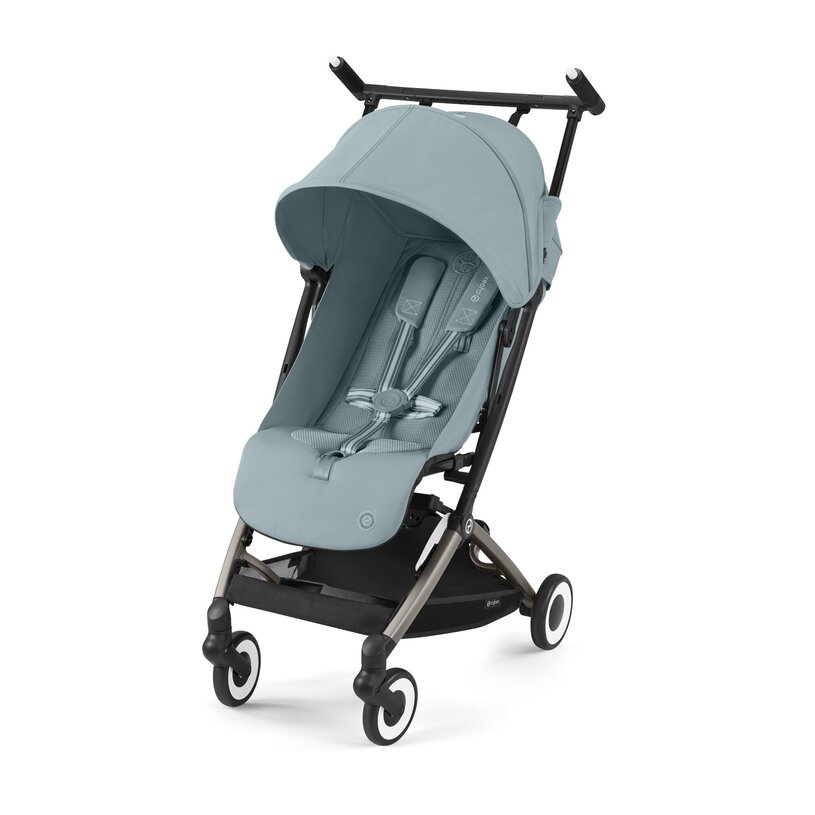
I wasn’t just browsing when I road tested the Cybex Libelle. I was shopping in earnest — looking for a lightweight buggy for my daughter K, who is slight of frame, uses public transport every day, and needed something she could genuinely manage with a toddler in tow. When you’re choosing a pushchair for someone else’s daily life rather than your own, you pay attention differently. You’re not thinking about how it feels to you. You’re thinking about how it’ll feel on the third staircase of the day, with a child on one hip and a changing bag on the other.
Why trust this review?
Tested by: Mark — hands-on shop road test, with K (my daughter, daily public transport user, slight of frame) also handling the pushchair and giving her verdict.
Evidence basis: In-store road test of steering, fold, and build. Real owner feedback from Louise — an experienced mum and sales professional who owns and uses a Libelle daily. Specs verified against cybex.com.
Conflict of interest: This review contains an Amazon affiliate link. This does not affect the verdict.
Cybex Libelle — At a Glance
- Headline strength: 5.9kg — one of the lightest pushchairs on the market, and it genuinely feels it
- Honest caveat: Two hands needed to fold, and small plastic wheels that are honest about where this pushchair belongs
- Distinguishing feature: Ultra-compact and ultra-lightweight combined — easier to control than the weight spec alone suggests
- Verdict in a sentence: A very good ultra-lightweight pushchair in a fiercely competitive segment — pipped by the YOYO³, Joolz Aer2 and Bugaboo Butterfly 2, but which one wins may come down to personal preference as much as specification
⭐ Best for…
- ⭐ Frequent flyers — 5.9kg and a compact fold make it one of the most travel-friendly options available
- ⭐ Slight-framed parents and grandparents — genuinely easy to lift, carry and control
- ⭐ Urban smooth-surface use — pavements, shopping centres, airports; the plastic wheels are perfectly suited
- ⭐ Public transport users — light enough to manage steps, barriers and bus aisles without a struggle
- 🚫 Not ideal for: rough terrain, broken pavements, or anyone who needs a one-handed fold
✅ What I liked
- 5.9kg — genuinely feels as light as the spec suggests
- Easy to control for a slight-framed parent
- Ultra-compact result when folded
- Smooth, easy manoeuvrability in store
- Competitive price for the segment
⚠️ What to watch
- Two hands needed to fold — matters if you regularly fold one-handed
- Small plastic wheels — perfect for smooth surfaces, limiting on rough ground
- Pipped by the YOYO³, Joolz Aer2 and Bugaboo Butterfly 2 overall
- Not a pushchair for mixed or rough terrain
MyPushchair scorecard
| Weight | ⭐⭐⭐⭐⭐ 10/10 (one of the lightest pushchairs on the market) |
| Manoeuvrability | ⭐⭐⭐⭐⭐ 9/10 (easy to control — confirmed by K and real-world owner) |
| Fold | ⭐⭐⭐⭐ 7/10 (compact result — two hands required) |
| Wheels/terrain | ⭐⭐⭐ 6/10 (perfect for smooth urban use; limiting elsewhere) |
| Build quality/feel | ⭐⭐⭐⭐ 7/10 (appropriate for its purpose and weight class) |
| Value | ⭐⭐⭐⭐ 7/10 (competitive segment — styling and price will drive final choice) |
| Overall | ⭐⭐⭐⭐ 7.5/10 |
Overall score: 7.5/10. The Libelle scores highly on what it’s designed to do — be as light and compact as possible while remaining genuinely easy to use. The marks it loses are honest trade-offs: the two-handed fold and plastic wheels are direct consequences of the weight target, not oversights. In a segment that includes the YOYO³, Joolz Aer2 and Bugaboo Butterfly 2, it sits just behind the very best — but the differences are real rather than vast, and in this price bracket personal preference on styling and fabric is a legitimate deciding factor.
Is the Cybex Libelle right for you?
A good choice if:
- Minimum weight is your overriding priority — at 5.9kg it’s one of the lightest options available
- You fly regularly and want something genuinely travel-friendly
- You’re slight of frame and need a pushchair that’s easy to lift and control
- Your daily use is smooth urban surfaces — pavements, shopping centres, airports
- You use public transport regularly and need something manageable on steps and through barriers
Think carefully if:
- You need a one-handed fold — the Libelle requires two hands, which matters if you’re regularly folding with a child on your hip
- Your daily route includes broken pavements or rough surfaces — you’ll notice the plastic wheels’ limits sooner than you would on the Butterfly 2
- You’re comparing closely with the Bugaboo Butterfly 2 or Joolz Aer2 — try all three if you can
💡 What surprised me most
I expected 5.9kg to feel nervous — all that saved weight sometimes translates to a pushchair that feels skittish and hard to control. Instead the Libelle felt surprisingly planted. I came away talking about the steering far more than the weight, which is not what I anticipated going in. K noticed the same thing.
🚫 Skip the Libelle if…
- You need a one-handed fold — there are better options if this is non-negotiable for your daily routine
- Your route includes broken pavements, cobbles or anything rougher than smooth tarmac — the plastic wheels will remind you of their limits
- You want the very best in the ultra-lightweight segment — the YOYO³ pips it overall
- Budget allows for the Butterfly 2 and a one-handed fold matters to you — it’s worth the extra
Why 1.4kg matters more than you think
You stop noticing a kilogram in a showroom. You definitely notice it on the third staircase of the day. The difference between the Libelle at 5.9kg and the Bugaboo Butterfly 2 at 7.3kg sounds marginal on paper — but when you’re carrying a toddler, a changing bag and a folded pushchair up a flight of steps at a train station, that 1.4kg is entirely real. For K, who does exactly this daily, it’s not a specification point. It’s the difference between a pushchair that works for her life and one that slowly becomes a burden.
The Libelle genuinely feels its weight. Lifting it is effortless. Tucking it under your arm after folding requires no real effort. For slight-framed parents and grandparents — the people who feel this kind of weight difference most acutely — that matters more than it does to someone who could carry a double pushchair up a flight of stairs without breaking stride.
The one situation where the Libelle will frustrate you
Buses don’t wait while you work out a fold mechanism. Neither do train doors. The Libelle needs two hands to fold — and whether that’s a dealbreaker depends entirely on your routine. If both hands are usually free when you fold, it’s a complete non-issue. If you regularly fold one-handed with a child on your hip at a bus stop, it’s a genuine limitation worth knowing before you commit.
We folded it several times in the shop specifically because this was the scenario we were stress-testing for K. The fold itself is compact and the result is genuinely small — that part isn’t in question. It’s purely the two-handed requirement that separates it from the Butterfly 2, whose near-instant one-handed fold is one of the best in the market. If that specific capability is non-negotiable for your daily life, the Butterfly 2 is the stronger tool and worth the extra money.
The cobbled high street problem
Small plastic wheels are the honest engineering consequence of a 5.9kg target. On smooth urban surfaces — pavements, shopping centre floors, airport terminals — they’re absolutely fine. For daily smooth-surface urban use, I’d expect them to look respectable and perform well for a long time. But if your daily route includes broken pavements, cobbles or anything approaching off-road, you’ll notice their limitations sooner than you would on the Butterfly 2’s larger wheels.
This isn’t a design flaw — it’s a description of the trade-off. You cannot have ultra-lightweight and full-terrain wheels in the same pushchair. The Libelle is honest about what it is: a smooth-surface urban and travel pushchair built around a weight target. If your life fits that description, the wheels are not a problem.
The grandparent test
K is slight of frame. Many grandparents are too. One of the practical questions I was running through in the shop was whether an older grandparent could lift this into a car boot without assistance. At 5.9kg, the honest answer is yes — considerably more easily than almost anything else in this market. The weight that makes it ideal for K on public transport is the same weight that makes it manageable for grandparents doing the school run or a weekend out with a grandchild.
The two-handed fold is worth factoring in here too. For a grandparent with any reduction in hand strength or dexterity, two hands on a fold mechanism is actually more manageable than a one-handed snap fold that requires a specific grip and confident single-hand pressure. It’s an angle worth considering if you’re buying with a grandparent user in mind.
Louise — an owner’s verdict
The sales assistant who helped us was Louise — an experienced mum who actually owned a Libelle and used it daily. She wasn’t trying to sell us the most expensive thing on the floor. She was telling us what she knew from real use: ultra compact, ultra lightweight, easy to control and manoeuvre. No hidden caveats, no upselling. Just honest knowledge from someone who’d put it through its paces in exactly the kind of daily use K was planning.
That kind of endorsement carries more weight than a showroom demonstration. When someone who owns the product you’re reviewing tells you the same things you found yourself, and does so without an agenda, it’s worth noting. Louise loved it. K’s verdict and mine, after handling it ourselves, was that it was very good — but not quite at the YOYO³ level overall.
Would I choose it? An honest verdict in a competitive segment
The ultra-lightweight compact segment is one of the most competitive in the pushchair market, and the Libelle sits in good company. The YOYO³, the Joolz Aer2 and the Bugaboo Butterfly 2 all pip it overall in my view — K agreed on the YOYO³ specifically. But the differences are real rather than vast, and I can absolutely imagine owning this pushchair. I just can’t quite imagine choosing it over the very best rivals if budget and personal preference were equal.
If I narrowed it down to these four pushchairs, I wouldn’t try to persuade someone that one is objectively correct. They’re all good. At that point, the one you enjoy pushing and looking at every day probably becomes the right choice — and the Libelle is a genuinely enjoyable pushchair to use.
How does it compare with the alternatives?
| If this matters most… | Choose… |
|---|---|
| Lowest possible weight | Cybex Libelle — 5.9kg, lightest in the segment |
| Fastest fold at a bus stop, one-handed | Bugaboo Butterfly 2 — one-second one-handed fold |
| Most premium overall feel in the segment | Stokke YOYO³ — pips the field overall |
| Scandinavian styling and one-handed fold | Joolz Aer2 — 6.2kg, distinctive design |
| Best value at minimum weight | Cybex Libelle — typically the most competitive price in the group |
Key specifications
| Weight | 5.9kg |
| Suitable from | 6 months (seat unit) — compatible with Cybex infant car seats from birth via adapters |
| Max child weight | 22kg |
| Fold | Two-handed, compact |
| Wheels | Small plastic — suited to smooth urban surfaces |
| Terrain | Smooth urban surfaces, pavements, airports, shopping centres |
| Car seat compatible | Yes — with Cybex infant car seats via adapters |
Also worth reading
- Cybex Libelle vs Bugaboo Butterfly 2 — lightest weight vs fastest fold
- Cybex Libelle vs Mamas & Papas Airo — lightest weight vs best everyday value
- Stokke YOYO³ vs Cybex Libelle
- Bugaboo Butterfly 2 Review — the closest direct rival
- Cybex hub — all Cybex models reviewed
- Best Lightweight Pushchairs
- Best Pushchairs for Flying
- Best Pushchairs for Public Transport
Verdict
The Cybex Libelle is a genuinely good ultra-lightweight pushchair. At 5.9kg it delivers on its core promise — easy to carry, easy to manoeuvre, compact when folded — and it handles better than its weight spec alone suggests. The honest trade-offs are real but logical: the two-handed fold will matter to some parents and not others, and the plastic wheels are entirely clear about where this pushchair belongs.
In one of the most competitive segments of the pushchair market, it’s a strong contender — very good without quite being the outright best. The YOYO³ pips it. So does the Butterfly 2 on fold. But the differences are not vast, and a pushchair you enjoy using every day is the right pushchair.
Bottom line: I can absolutely imagine owning this pushchair. I just can’t quite imagine choosing it over the very best rivals if budget and personal preference were equal. If you try it alongside the YOYO³, Aer2 and Butterfly 2 and the Libelle is the one that feels right — that’s a perfectly sound choice.
💬 If this were my money…
If I needed the lightest pushchair possible for daily train journeys or regular flying, I’d happily buy the Libelle. If I could stretch another £100–£150 and folded it several times a day one-handed, I’d buy the Bugaboo Butterfly 2 instead. If overall refinement and feel mattered more than absolute weight, I’d choose the YOYO³.
Affiliate link — we earn a small commission if you buy, at no extra cost to you.
Frequently asked questions
How heavy is the Cybex Libelle?
5.9kg — one of the lightest pushchairs on the market. It genuinely feels as light as the spec suggests, which isn’t always the case with ultra-lightweight pushchairs.
Does the Cybex Libelle fold with one hand?
No — the Libelle requires two hands to fold. Whether this matters depends on your routine. If you regularly fold one-handed with a child on your hip, the Bugaboo Butterfly 2 is a better tool. If both hands are usually free when you fold, it’s a non-issue.
Is the Cybex Libelle good for rough terrain?
No — it has small plastic wheels designed for smooth urban surfaces. Pavements, shopping centres and airports are its natural habitat. For mixed or rough terrain a different pushchair is the right choice. See our all-terrain pushchair guide for alternatives.
Cybex Libelle vs Bugaboo Butterfly 2 — which is better?
The Libelle is lighter (5.9kg vs 7.3kg) and typically cheaper. The Bugaboo Butterfly 2 has a one-second one-handed fold and Bugaboo’s premium build quality. In my view the Butterfly 2 pips it overall — but the weight difference is real and the price difference may be the deciding factor. Try both if you can.
Cybex Libelle vs Stokke YOYO³ — which should I choose?
The YOYO³ pips the Libelle overall — both my daughter K and I agreed after handling both. That said, the Libelle is lighter (5.9kg vs 6.2kg) and typically cheaper. In a segment where styling and fabric matter as much as specification, try both before deciding.
Can the Cybex Libelle be used from birth?
The seat unit is suitable from 6 months. For use from birth, it’s compatible with Cybex infant car seats via adapters — making it a travel system option for newborns.
Is the Cybex Libelle good for flying?
Yes — at 5.9kg with a compact fold, it’s one of the more travel-friendly pushchairs available. Always check your specific airline’s cabin baggage dimensions before travelling. Our pushchairs for flying guide has the full breakdown.
📋 See all our Cybex reviews: Cybex Pushchairs — Hub & Buying Guide →
About the reviewer
Mark founded MyPushchair.co.uk in 2006 after struggling to find honest, straightforward pushchair advice as a new dad. With more than 30 years in the family travel and leisure industry — and after returning to relaunch the UK’s original independent pushchair review site — he continues to test products with one aim: helping parents buy the right pushchair the first time. Read the full story →
Considering the Cybex Libelle and want a second opinion on whether it fits your situation? Get in touch — happy to help.