
This page contains affiliate links. If you click through and make a purchase we may earn a small commission at no extra cost to you. Full disclosure here.
Why trust this guide? This page is built on real, daily experience — my daughter K and her partner B use trains across West Yorkshire most days, with two young children and a pushchair. What follows isn’t theory about train travel with a pushchair, it’s what’s actually happened to them, including a recent incident that’s exactly the kind of thing this page exists to help you avoid.
Pushchairs on Trains — At a Glance
- The platform-train gap is the main hazard — not the step, the gap. It can be wide enough to lose more than just a phone down.
- Board forwards, exit backwards. Pushing the pushchair in front of you to board, then backing it off the train to exit, is the safer technique — and what many rail staff and experienced pushchair users recommend.
- Many smaller stations are unstaffed, especially at certain times of day. Help isn’t guaranteed — you may be relying on whichever staff happen to be on the train, not on the platform.
- Boarding ramps exist but aren’t automatic. Northern and most operators carry ramps and will help where they can, but you may need to ask, and there’s no certainty someone will be there to ask.
- Width matters as much as it does on a bus — a pushchair that’s a squeeze through a train door becomes a real problem at a busy platform with people trying to get past you.
- Keep your phone in a pocket, not your hand or the pushchair tray, while boarding — this page exists partly because that’s exactly what went wrong for one family.
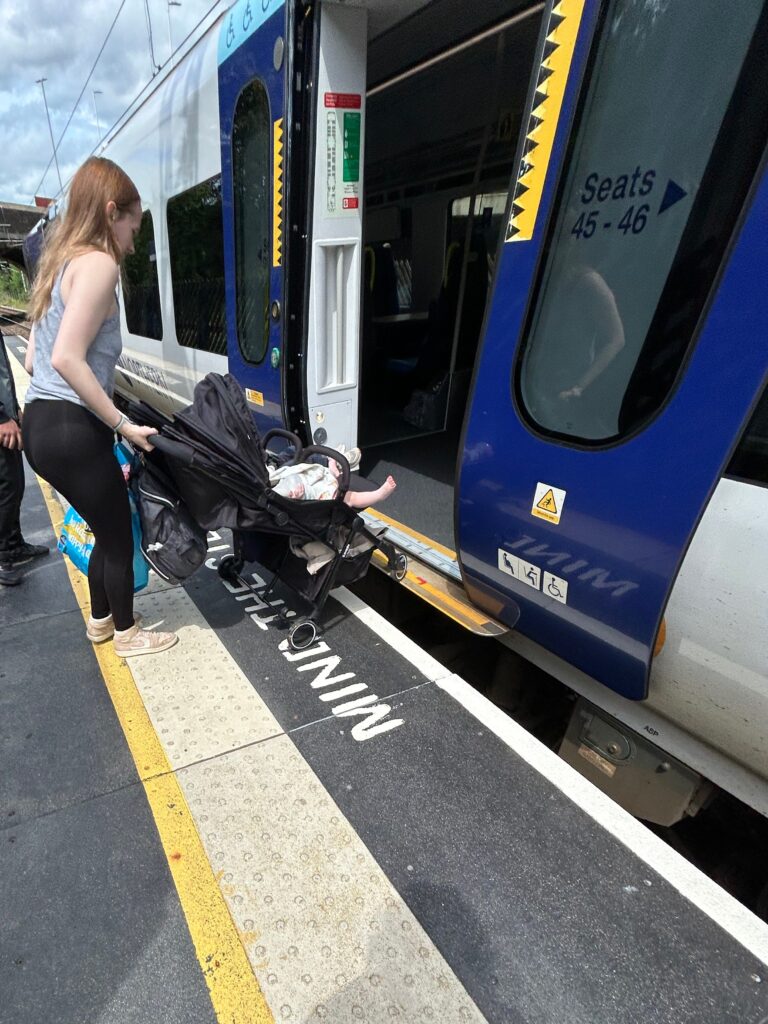
Pushchairs on trains come with one hazard most advice doesn’t mention. A couple of weeks ago, my daughter K was boarding a train at Crossflatts station with her partner B and their two children. B’s recently had an operation on his arm, so for now he can’t help lift the pushchair — which meant K was managing the pushchair, the gap between the platform and the train, and both children largely on her own.
As she was getting the pushchair across the gap, another woman on the platform knocked into her. K’s phone went straight down into the gap between the train and the platform edge.
A ticket inspector happened to be on the train that day — Crossflatts itself is an unstaffed station, so that’s not guaranteed — and once it was safe to do so, he was able to reach down and retrieve the phone. It came back smashed at the back, but it came back. Nobody was hurt, and the phone was replaceable. It could easily have gone very differently.
This isn’t a frequent occurrence, and most journeys with a pushchair pass without incident. But it’s a realistic illustration of what happens when a few small risks line up at once — a wide gap, a moment of distraction, and someone else’s misjudged step on a crowded platform.
Why the gap is the real hazard, not the step
Most advice about trains and pushchairs focuses on the step up into the carriage. That’s real, but it’s not actually the thing that catches people out. The gap between the platform edge and the train itself is the bigger problem — it’s often wider than people expect, and unlike the step, it’s not something you can simply lift over. Anything that drops — a phone, a shoe, a toy — can go straight down it.
Most UK stations have some form of step-free access and many trains carry boarding ramps that staff can put down across the gap when needed. But “the ramp exists” and “someone is there to put it down for you” aren’t the same thing, especially at smaller, unstaffed stations. Northern, like most operators, says it’s committed to helping families with pushchairs board and alight, and staff will help where they can — but that’s different from a guarantee that staff will be present at every station, every time.
The risk isn’t really just the gap on its own — it’s the limited attention window you have while you’re crossing it. You’re often boarding or alighting under genuine time pressure, with other passengers moving around you, trying to get on or off the same train in the same few seconds. That’s exactly what causes shoulder bumps, a wobble with the pushchair, or a dropped phone — not the gap in isolation, but the gap combined with everyone else’s hurry.
The practical takeaway: treat the gap itself as the danger zone, not just an inconvenience to get over quickly. Keep your phone in a pocket rather than in your hand or balanced on the pushchair tray while you’re actually crossing it, and be aware that the few seconds spent managing a pushchair across that gap are also the few seconds you’re most exposed to anyone else on a crowded platform.
It’s also worth knowing the gap isn’t the same everywhere. A straight platform alongside a straight section of track usually has a smaller, more predictable gap. Curved platforms can have a noticeably wider horizontal gap, since the train itself curves away from the platform edge. Smaller, rural or less-used stations are often where this is most variable, simply because they’re less likely to have had platform-edge improvements done. None of this means avoid certain stations — it just means the gap at your regular station might be quite different from the gap somewhere new, so it’s worth a bit of extra care the first time.
Board forwards, exit backwards
This is the single most useful technique K and B have picked up from genuinely doing this every day: push the pushchair onto the train facing forwards, and back it off again when you get off. Many rail staff and experienced pushchair users recommend this as the safer way round, rather than trying to pull a pushchair backwards onto a train or push it forwards off one — both of which make it much harder to see exactly where the wheels are landing relative to the gap.
It feels a little unnatural the first few times, particularly getting off — your instinct is to walk forward off the train the way you’d walk off anything else. But reversing the pushchair off gives you a clear view of the gap and the platform edge as you’re crossing it, rather than trying to judge it from behind the handlebar while walking forwards into a closing door or a crowded platform.
Pushchairs on trains — what actually matters
Width. The same problem as buses — a pushchair that’s a squeeze through a train door is manageable when the platform’s empty, and a genuine problem when it isn’t. Doors and the vestibule space just inside them are narrower than people expect on most train types.
A fast, reliable fold. Not every journey gives you the luxury of keeping the pushchair open. On a busy service, you may need to fold it quickly to find space, with a baby on your hip and a queue of people waiting to get past you.
Stability over a gap, not just smooth-floor manoeuvrability. A pushchair that feels easy to push around a shopping centre can behave differently when one set of wheels is crossing a gap and the other set is still on solid ground. Sturdier wheels and a frame that doesn’t flex matter more here than they do on a flat pavement.
Somewhere secure to store essentials. K uses a backpack-style changing bag clipped to the pushchair handlebar with carabiner clips, which keeps both hands free for managing the pushchair itself rather than juggling a bag at the exact moment she needs both hands on the frame.
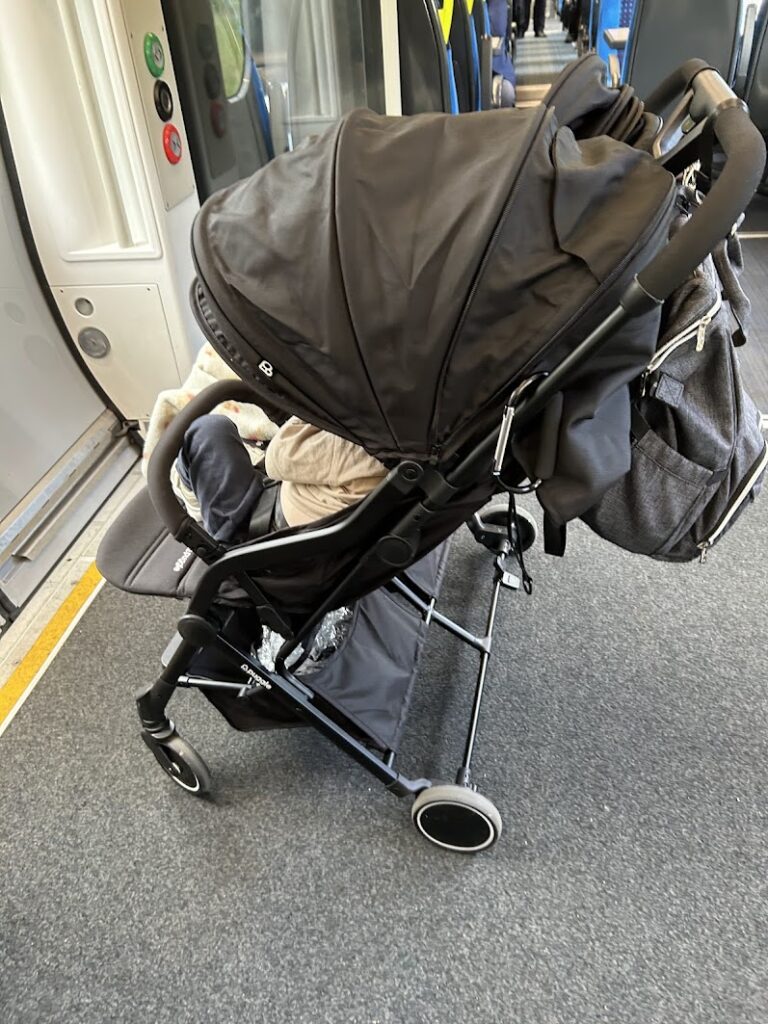
For day-to-day train use with two children, K and B currently use a Puggle City Traveller double. It folds down compactly and — usefully, for managing it on a platform or in a train vestibule — stands up on its own once folded, so you’re not trying to lean it against something or hold it upright with one hand while you’re also managing two children.
Storage on board
Most Northern trains don’t have a dedicated pushchair space the way some routes have a dedicated bike space — pushchairs typically go in a vestibule area, a wheelchair/wheelchair-priority bay if it’s free, or wherever there’s room, at the discretion of whoever’s on board that day. Worth knowing this in advance rather than assuming there’ll be a specific spot waiting for you.
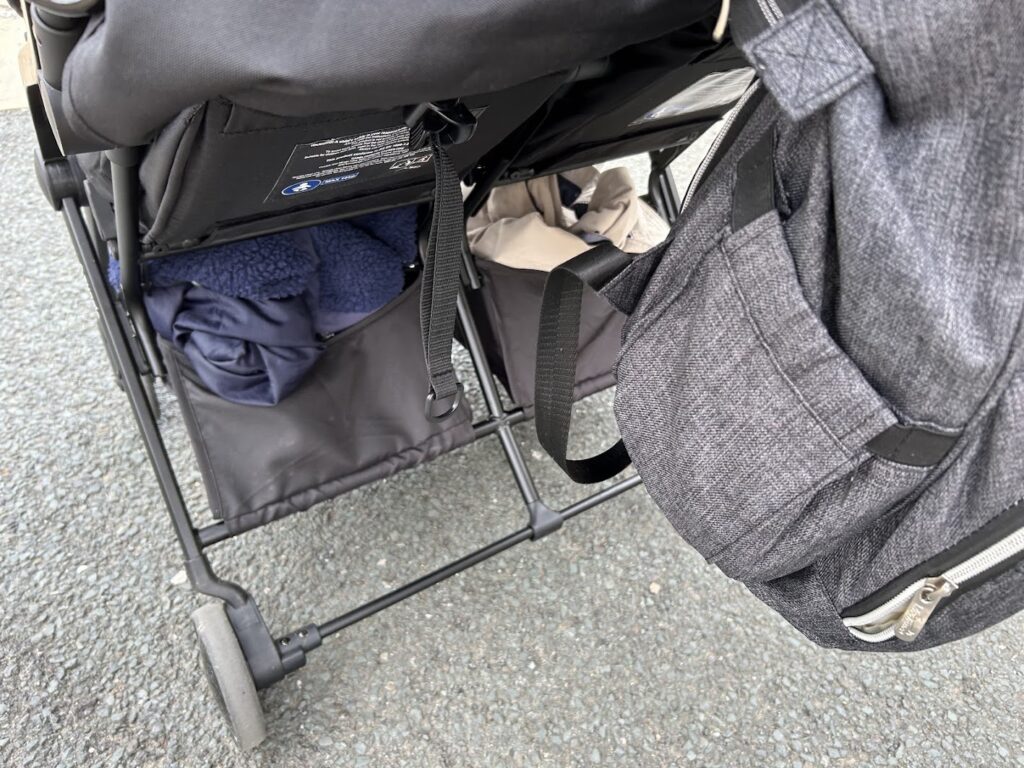
The underseat basket on a pushchair is genuinely useful here — K keeps food, spare layers and other essentials in hers rather than a separate bag, which means less to manage on top of the pushchair itself when space is tight.
[Image: underseat basket storage in use]
If something does go wrong
K’s experience is the clearest possible illustration of one thing: if something drops down the gap, don’t try to retrieve it yourself while the train’s anywhere near the platform. The ticket inspector who helped her only did so once it was safe — and that’s the right call, even though it’s hard to watch a phone (or anything else) disappear and wait.
Prevention matters more than knowing what to do afterwards, and it’s mostly about removing the things that can drop in the first place: phone in a pocket rather than your hand, nothing balanced on the pushchair tray while you cross the gap, and a moment’s awareness of who else is moving around you on the platform before you start. If something does go wrong anyway, find station staff if the station is staffed, or a conductor or guard if not, and let them retrieve it once it’s genuinely safe. It’s worth the wait.
Frequently Asked Questions
Do I need to fold my pushchair to get on a train?
Not always — folded pushchairs are accepted everywhere, but plenty of journeys are fine with it left open if the train isn’t busy and there’s space. On a crowded service, you may be asked to fold it, or simply need to for your own and others’ comfort.
Will staff help me get a pushchair on and off the train?
Often, but not guaranteed. Operators generally say they’re committed to helping families with pushchairs, and ramps are carried on most trains for the gap between platform and carriage. Many smaller stations are unstaffed, though, so help depends on whether a conductor or guard happens to be on board, not on station staff being present.
What’s the safest way to board and exit with a pushchair?
Forwards in, backwards out. Push the pushchair onto the train facing forward, and reverse it off again when you reach your stop — it gives you a clearer view of the gap and the platform edge than trying to do it the other way round.
Is there a dedicated space for pushchairs on trains?
Not usually, on most regional services. Pushchairs typically go in a vestibule area or a wheelchair priority space if it’s free, rather than a space reserved specifically for pushchairs. Be ready to be flexible about where you end up.
What should I do if something falls down the platform gap?
Don’t try to retrieve it yourself while there’s any train movement or risk nearby. Find station staff if the station is staffed, or a conductor or guard if not, and let them retrieve it once it’s genuinely safe to do so. It’s worth the wait.
This page is part of our Best Pushchairs for Public Transport guide and our Travelling with a Pushchair hub — both worth reading alongside this if you’re planning journeys beyond just trains.
Got a train journey coming up with a pushchair and not sure what to expect? Navigating pushchairs on trains gets easier fast once you know what to watch for. Get in touch — happy to help.